
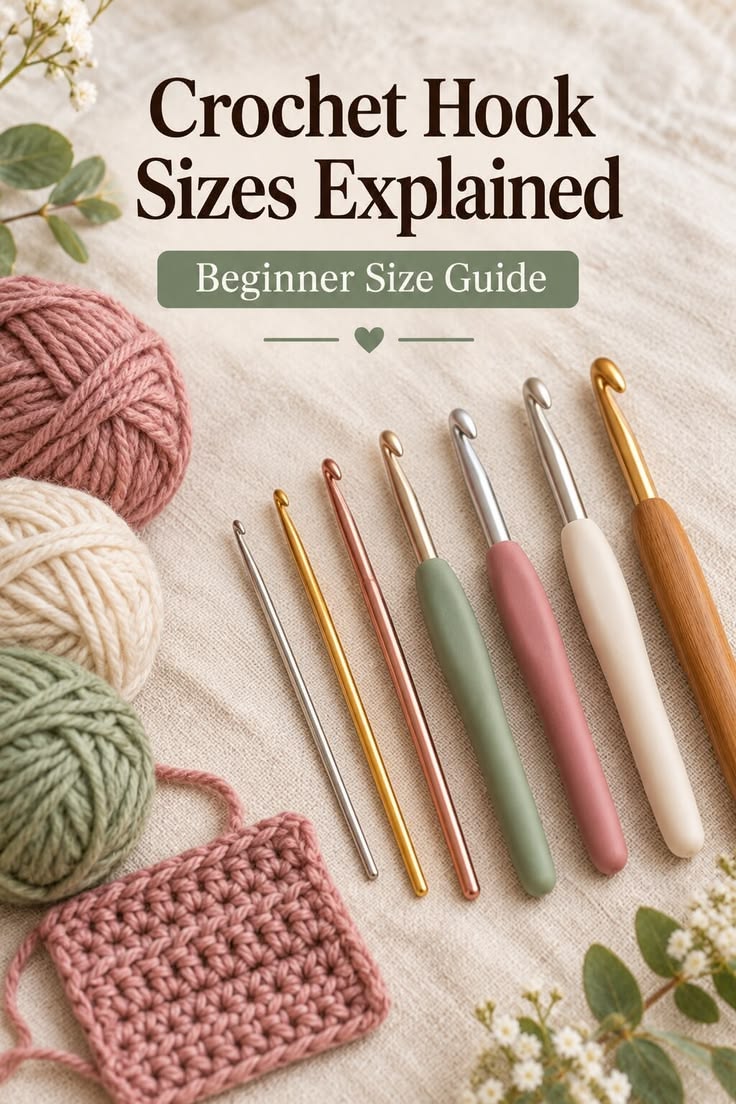
Crochet hook size changes the size of each loop, the density of the fabric, the amount of drape and sometimes how comfortable the project feels in your hands. The hook suggested on a yarn label is a useful starting point, but the right hook is the one that produces the pattern gauge and fabric you need.
This guide explains metric and US sizing, how to adjust a hook after swatching, and how aluminium, steel, wood, bamboo, plastic and ergonomic handles behave with different yarns.
What crochet hook size means
Hook size usually refers to the diameter of the shaft, measured in millimetres. A 4 mm hook has a narrower shaft than a 6 mm hook. US letters and numbers are common, but their exact mapping can vary slightly by manufacturer. The millimetre marking is the clearest value to compare.
Common starting ranges
These are practical starting points, not promises. Your pattern and gauge take priority.
- Lace and super-fine yarn: often paired with small hooks for delicate fabric, or larger hooks for airy lace.
- Sport and DK yarn: commonly worked with mid-small hooks for light garments and accessories.
- Worsted and aran yarn: often paired with mid-range hooks and is easy for beginners to handle.
- Bulky and super-bulky yarn: usually needs larger hooks so the fabric does not become rigid.
- Thread crochet: steel hooks use a separate numbering system; always check the metric size.
For the standard thickness categories from 0 Lace to 7 Jumbo, use our Yarn Weights Explained guide.
Start with the yarn label, then swatch
The label recommendation gives you a reasonable first hook. A designer may choose a different size for a tighter bag, a drapey garment, open lace or amigurumi. Crochet a swatch in the actual pattern stitch, wash and dry it according to the project instructions, and measure after it has rested.
How to correct gauge
- Too many stitches across the measured width: your stitches are too small; try a larger hook.
- Too few stitches: your stitches are too large; try a smaller hook.
- Stitch gauge matches but row gauge does not: adjust stitch height and technique, or follow the pattern’s instructions for adding/removing rows.
- Gauge matches but the fabric feels wrong: test a different yarn construction or fiber instead of forcing the hook size.
Change one variable at a time and label every swatch. A quarter-millimetre or half-millimetre change can matter in fitted garments.
Larger hook versus smaller hook
A larger hook
A larger hook normally creates bigger loops, more drape and more open spaces. It can soften a stiff yarn, but it may make stuffing visible in toys or reduce a bag’s structure.
A smaller hook
A smaller hook normally creates a tighter, denser fabric. It can help with amigurumi and structured bags, but an excessively small hook makes the hands work harder and can create a board-like fabric.
Crochet hook materials
Aluminium
Aluminium hooks are light, smooth and widely available. They help many yarns move quickly, which is useful when a grippy fiber drags. Very slippery yarn may move faster than a beginner wants.
Steel
Steel hooks are strong and commonly used in the smallest sizes for crochet thread. Their numbered sizing is not the same as standard US letter sizing, so use the millimetre mark.
Bamboo and wood
Wood and bamboo often add surface grip. That can improve control with smooth bamboo-viscose or silk-like yarns. Finishes differ: inspect the tip and throat for rough areas that might catch fibers.
Plastic and resin
Plastic hooks can be lightweight and affordable, especially in larger sizes. Flex and surface smoothness vary. Replace any damaged hook with sharp seams or rough edges.
Ergonomic handles
A larger padded or shaped handle can reduce how tightly you pinch the hook. It does not guarantee pain-free crocheting. Take breaks, vary tasks and stop if you experience persistent pain, numbness or tingling.
Inline and tapered hook heads
Inline hooks tend to keep the head and shaft in a straighter profile, while tapered hooks narrow toward the head. Neither is universally better. Your grip style, stitch pattern and yarn determine which feels easier. Try one of each before buying a large set.
Matching hook feel to yarn
- Smooth metal can help firm cotton yarn move more freely.
- Wood or bamboo may add control to slippery bamboo-viscose yarn.
- A smooth rounded tip can reduce splitting in loosely plied acrylic yarn.
- For elastic wool or merino, choose the hook that lets you keep relaxed, consistent tension.
A practical beginner hook set
Rather than buying every size, begin with several mid-range metric hooks that suit medium yarn, plus a tape measure and stitch markers. Add smaller or larger sizes when a chosen pattern requires them. A 5 mm hook and smooth category 4 Medium yarn are a common practice combination, but they are not a universal rule.
Common hook-size mistakes
- Copying the designer’s hook without checking your own gauge
- Comparing letter labels while ignoring millimetres
- Using a smaller hook to fix every loose fabric problem
- Making a tiny swatch that does not represent the finished fabric
- Measuring before the swatch is washed and rested
- Continuing through hand pain instead of adjusting grip, handle or break schedule
Crochet hook FAQ
What hook size is best for beginners?
A mid-range hook paired with smooth, light-colored category 4 yarn is easy to see and control. The yarn label gives a useful first size.
Can I use a different hook than the pattern?
Yes. Many crocheters need a different size to match gauge. Change the hook until the washed swatch matches and the fabric still feels appropriate.
Why is my crochet so stiff?
Your hook may be too small, your grip may be tight, or the yarn may be too dense for the design. Try a larger hook and a relaxed swatch.
Choose the yarn with the hook
Continue with the complete crochet yarn and materials guide, then browse free crochet patterns and swatch with the hook that gives the required fabric.