
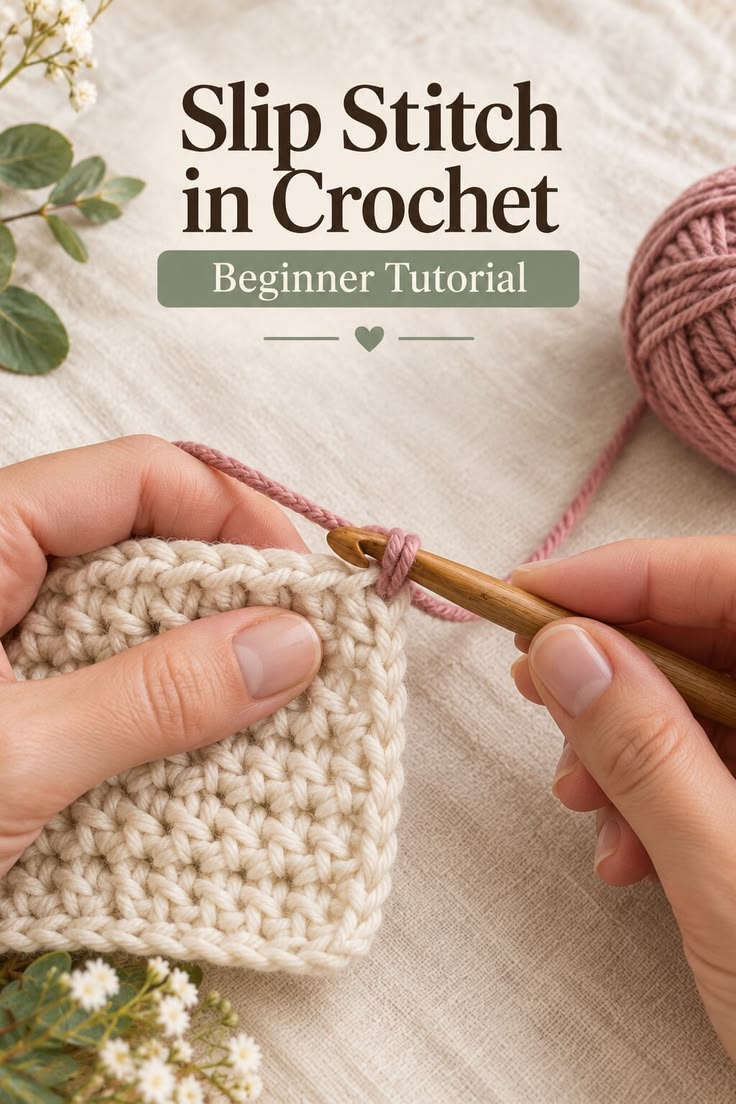
The crochet slip stitch is one of the smallest and simplest crochet stitches, but it appears in many patterns. You will use it to join rounds, move across stitches without adding height, close edges and create decorative textures.
What is a slip stitch?
A slip stitch is made by inserting the hook into a stitch, catching the yarn and pulling it through both the stitch and the loop already on your hook in one motion. It creates almost no height.
What you need
- Smooth medium-weight yarn
- A matching crochet hook
- A short practice chain
Step 1: Make a practice chain
Make a slip knot and chain about 12 stitches. Keep your chain loose so the hook can enter each stitch easily.
Step 2: Insert the hook
Insert the hook into the second chain from the hook. For practice, insert under the top loop or under both loops if that feels more comfortable.
Step 3: Yarn over and pull through
Yarn over and pull the yarn through the chain and immediately through the loop already on your hook. One slip stitch is complete.
Continue across
Repeat the same movement in each stitch. The fabric will stay very flat and compact because slip stitches do not build much height.
Where slip stitches are commonly used
Joining a round
Many circular patterns ask you to join the final stitch to the first stitch with a slip stitch. This closes the round neatly.
Moving to a new position
A pattern may tell you to slip stitch across several stitches so you can reach the next working area without creating a tall row.
Edging and texture
Rows of slip stitch can create a dense, stretchy texture. Slip stitches are also useful for neat borders around finished projects.
Common beginner mistakes
Making the stitches too tight
Slip stitches naturally become compact, so avoid pulling the working yarn too firmly. Let the loop stay relaxed around the hook.
Adding an extra yarn over
A slip stitch only needs one yarn over after the hook is inserted. Pull that yarn through everything in one continuous movement.
Confusing it with single crochet
Single crochet creates two loops on the hook before the final yarn over. A slip stitch passes through the stitch and the loop already on your hook immediately.
Simple practice exercise
Chain 15 and work one row of slip stitches. Then compare it with a row of single crochet. You will quickly see how much flatter and tighter the slip-stitch row is.
Learning slip stitch makes many beginner patterns easier to understand because it is often used for joining, finishing and positioning.